Recruitment Process Outsourcing (RPO)

RPO, or Recruitment Process Outsourcing, allows businesses to hand over some (or all) of their recruitment processes to a third-party RPO provider. It’s like having a dedicated team of workforce specialists who handle everything – from identifying your talent needs to sourcing, screening, and onboarding the best candidates.

A common view is that RPO services are only for large companies hiring over 1,000 employees a year, but that’s not the case. RPO is flexible and works just as well for businesses with smaller hiring volumes as for those scaling up.

Who is RPO for?

Your business could benefit from an RPO provider if…

Hiring takes too long

Slow recruitment is causing delays. RPO providers help you fill roles faster and keep projects on track.

Hiring takes too long
Recruitment costs are unclear and rising

You’re spending too much on hiring but are not sure why. RPO identifies inefficiencies and optimises your process to save money.

Recruitment costs are unclear and rising
Specialist knowledge is lacking

Your team struggles to hire niche talent. An RPO model connects you with expert recruiters and industry-specific talent.

Specialist knowledge is lacking
In-house team relies on a PSL

Even with an internal team, you rely on a preferred supplier list to fill 30 - 40% of roles. RPO optimises and strengthens your hiring processes.

In-house team relies on a PSL
Brand reputation is suffering

Bad candidate experiences are hurting your brand. RPO hiring improves the candidate journey, making your hiring more appealing.

Brand reputation is suffering
Compliance and managing talent are getting harder

As your company grows, managing recruitment, compliance, and onboarding across various industries and regions becomes more complex. Recruitment process outsourcing is designed to handle it all.

Compliance and managing talent are getting harder
Lack of long-term workforce planning

An RPO provider helps you plan for the future by supporting every stage of the workforce lifecycle, from recruitment and training to Statement of Work (SOW) management.

Lack of long-term workforce planning

Our RPO Solution

Rullion’s Recruitment Process Outsourcing Services

  • Benefits of working with us

Why choose Rullion as your RPO provider?

We are specialists in critical infrastructure recruitment and know what it takes to truly unlock the full potential for your workforce.

More than recruitment

We cover the full range of workforce solutions, from sourcing and training new talent with our Train to Deploy solution to integrating experienced recruitment professionals into your team through our Embedded Resource service.

Experts in critical infrastructure hiring

From Transport and Rail to Utilities and Energy to Nuclear, we understand the ins and outs of key critical infrastructure sectors.

Commitment to sustainability

We incorporate equity, diversity, inclusion, and sustainability into your recruitment process to ensure a long-term, positive impact and help you achieve your ESG objectives.

NPS score of 93

With an NPS of 93 (well above the industry average of 29!), our clients trust us to deliver results, helping you avoid delays and uncover cost-saving opportunities across your recruitment process.

Candidates enjoy working with us

Bringing in the best, most engaged talent is just the start. Every candidate interaction matters to us. Strong relationships with talent communities mean access to great candidates whenever needed. 

Tailored solutions that fit you

Flexibility is built into every recruitment solution. Fixed budgets cover core services, with optional add-ons to complement your in-house capabilities. Our RPO services connect your workforce needs with the right talent, exactly when you need it.

Data and AI insights

Use our advanced technology and AI-powered reporting tools to make data-driven hiring decisions and improve outcomes.

Our frequently asked questions

Recruitment Process Outsourcing FAQs


Our FAQs cover the most common questions about what RPO is and how it can help your business. 

Recruitment Process Outsourcing (RPO) is when a company transfers some (or all) of its recruitment process to a third-party RPO provider. It’s a dedicated recruitment team that handles everything from identifying your talent gaps to sourcing, screening, and onboarding.

  • Cost efficiency: Reduces time and cost pressures on your internal recruiters and recruitment advertising expenses.

  • Scalability: Easily ramp hiring up or down based on demand.

  • Access to expertise: Gain specialist recruiters and advanced recruitment technology.

  • Improved quality of hire: RPO providers use specialist knowledge and efficient AI data-driven methods and talent analytics to find better matches.

  • Faster hiring: Streamlined processes and large talent networks speed up time-to-hire.

  • Enhanced employer branding: RPO partners often help enhance your brand image to attract quality candidates.

There are typically three main types of RPO hiring solutions: 

End-to-End RPO: The RPO provider manages the entire recruitment lifecycle, from job profiling to onboarding.

On-Demand RPO: Used for specific projects or short-term hiring spikes, like seasonal hiring or new product launches.

Hybrid RPO: A flexible partnership that integrates with your internal team to share the recruitment workload, taking ownership of selected areas like sourcing, screening, or candidate engagement.

RPO differs from traditional hiring in that it involves a long-term partnership rather than a one-time service. An RPO provider collaborates with your team to manage all or part of your hiring process, with a focus on improving quality, speed, and cost efficiency. Traditional recruiting, on the other hand, is typically short-term and geared towards filling specific roles quickly, often for a fee per hire.

RPO is a good fit if your business hires regularly (regardless of company size) and needs help managing recruitment costs or wants to improve hiring quality. It’s especially useful if your HR team is overwhelmed or if you experience frequent unpredictable hiring patterns.

Chat with our RPO experts

Talk to our team about critical infrastructure recruitment through our RPO solution.

What our customers say about us

Real stories from the people and organisations we support

Discover why people trust us with their careers and hiring needs.

What's on your mind?

Our insights and tips on some of your most burning questions

NEWS
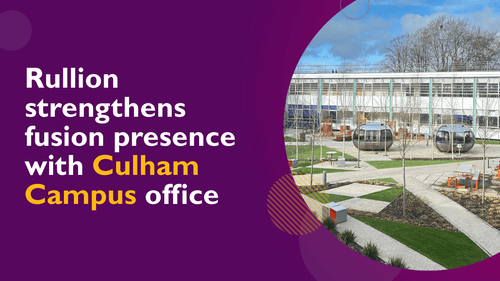
Rullion strengthens fusion presence with Culham Campus office

Rullion strengthens fusion presence with Culham Campus office

Rullion has relocated its Fusion team to a new office at Culham Campus, strengthening its presence at the centre of the UK’s fusion community. The team has long supported organisations based at Culham, but establishing a new home on campus marks a deeper commitment to the fusion sector. As the site continues to grow as a hub for fusion research, technology development, and commercial collaboration, being embedded within that environment enables closer working relationships across the wider fusion ecosystem, including organisations such as the UK Atomic Energy Authority (UKAEA). John Shepherd, Client Services Director, shared his perspective on strengthening Rullion’s presence at the heart of the fusion sector: “Culham Campus sits at the centre of the UK’s fusion community. Having our team based here reflects how important it is to work alongside the organisations driving this technology forward. Fusion represents a major opportunity for the future of energy, and delivering it will depend on building a workforce with highly specialised skills. Our role is to support that growth by connecting organisations with the talent they need, both in the UK and internationally.” Rullion is a proud member of the Fusion Skills Council and continues to play an active role in addressing the workforce demands facing the sector. As fusion moves from research into increasingly complex engineering and commercial programmes, access to specialist capability is becoming more significant. The team supports both contingent hiring and permanent hiring across highly technical disciplines, including: Plasma Physicists Tritium Fuel Cycle Engineers Cryogenics Consultants Tokamak specialists Robotics Engineers Alongside this, Rullion has expanded its international recruitment capability, supporting global mobility and bringing expertise to the UK where it is needed. This enables fusion organisations to access talent from established scientific and engineering markets including: Australia France Italy Switzerland By basing the team at Culham Campus, Rullion is reinforcing its position as a leading recruitment partner within the fusion sector and strengthening the relationships that will shape the next phase of fusion energy development.

By Rullion on 04 March 2026

NEWS
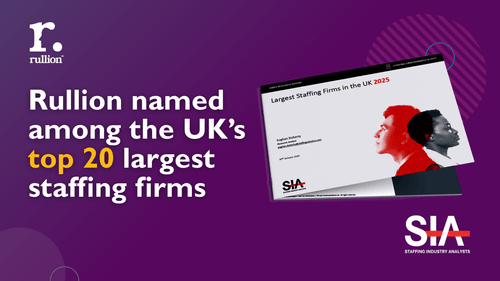
Rullion Named in the UK’s Top 20 Largest Staffing Firms by SIA

Rullion Named in the UK’s Top 20 Largest Staffing Firms by SIA

Rullion has been named by Staffing Industry Analysts (SIA) as one of the 20 largest staffing firms in the UK, recognising the scale of our role as a leading recruitment and workforce solutions provider nationwide and across Europe. The annual ranking places Rullion alongside the country’s leading providers supporting organisations with complex hiring and workforce challenges. Across critical infrastructure sectors including energy, nuclear, rail, and utilities, Rullion works in partnership with organisations to build and manage skilled project teams and wider workforce programmes that support long-term delivery. This can range from scaling engineering capability for major capital projects to overseeing managed service models that bring structure and consistency to high-volume hiring. Rullion’s services span permanent recruitment, temporary recruitment, and managed workforce solutions, including MSP and RPO models that support organisations through periods of transformation and long-term infrastructure investment. By combining sector expertise with flexible workforce delivery, Rullion helps clients improve workforce planning and strengthen access to scarce skills, all while maintaining continuity across complex national programmes. “This recognition reflects the work our teams do every day alongside our customers delivering critical infrastructure across the UK and Europe. The challenges our clients face require deep sector understanding and workforce solutions that adapt as projects evolve. Being named among the UK’s largest staffing firms is a result of the strong partnerships we’ve built and the practical, high-quality recruitment support we continue to deliver.” – Lindsay Harrison, Chief Customer Officer The SIA ranking provides independent recognition of Rullion’s continued growth as a workforce solutions provider supporting organisations responsible for some of the UK’s most important infrastructure programmes.

By Rullion on 26 February 2026

BLOG
RPO vs Traditional Recruitment: Which hiring model is right for you?

RPO vs Traditional Recruitment: Which hiring model is right for you?

The evolution of permanent recruitment models has been remarkable over the past ten years. The once simple decision between in-house and agency recruitment has evolved into a dynamic landscape saturated with options, all designed to provide organisations with enhanced flexibility, control, and efficiency. The three most common models include Permanent Recruitment, Recruitment Process Outsourcing (RPO), and RPO On-Demand. Each serves a different purpose, but understanding where one ends and another begins can be challenging. Each plays a unique role in the journey of business growth, yet understanding the transition from one to the next can be difficult. This bitesize guide outlines the unique offerings of each model, highlights their differences, and provides insights on selecting the approach that aligns perfectly with your hiring requirements. Click to navigate: What is permanent recruitment? What is an RPO? What is RPO On-Demand? What is Permanent Recruitment? Permanent recruitment, commonly known as perm recruitment, represents the classic agency model that many businesses recognise. This approach focuses on securing permanent employees rather than relying on temporary or contract arrangements. Agencies are often engaged by clients to enhance their internal hiring teams or talent acquisition efforts, either for particular positions or when specialised knowledge is needed. The recruitment agency identifies, screens, and presents candidates for specific roles. It continues to be the preferred choice for organisations in need of flexibility or assistance with specialised positions. Yet, permanent recruitment models vary significantly. Here are the three primary approaches: Contingency: Multiple agencies vie to fill the same vacancy, with payment awarded solely to the agency that successfully places a candidate. This approach emphasises rapid execution and network reach, but it may result in inconsistent quality. Exclusive: A single agency is granted exclusivity to fill the role within a specified timeframe. The recruiter can dedicate more time in sourcing and screening, free from competing with others. Retained: An agency is formally engaged on a retained basis (often with part payment upfront) to conduct a bespoke search. This is common for senior, specialist, or hard-to-fill roles and involves a consultative partnership that includes thorough candidate assessments. Many clients manage agency relationships through a bank of approved agencies, called a Preferred Supplier List (PSL). Some PSLs are tightly structured with defined service levels and performance reviews; others evolve informally based on trust and track record. Over time, HR or talent teams learn which partners deliver best for particular disciplines or regions. For agencies, earning a spot on a PSL means proving consistent delivery and understanding a client’s culture beyond individual vacancies. When Perm Recruitment is most effective Permanent recruitment offers flexibility and taps into extensive networks, but it can become expensive or unpredictable when scaling up hiring efforts. This model is ideal for: Companies experiencing minimal or consistent recruitment activity. Companies in need of specialised talent that is hard to find within their own ranks. Businesses seeking quick solutions without the burden of long-term obligations. What is an RPO? Recruitment Process Outsourcing, commonly known as RPO, involves delegating all or part of your recruitment function to an external provider. An RPO partner integrates seamlessly into your organisation, taking charge of recruitment from start to finish or at specific stages, rather than tackling each vacancy individually. This partnership is designed to enhance efficiency while elevating candidate quality and ensuring predictable costs. Some RPO partners go beyond the conventional scope of recruitment to also cover workforce planning, internal mobility, and talent analytics. How RPO transforms hiring The RPO model gives organisations enterprise-level capability without expanding their internal headcount. A mature RPO solution will often go beyond typical RPO hiring to build an infrastructure recruitment that seamlessly combines specialist knowledge and operational excellence. The RPO model gives organisations with enterprise-level capabilities while keeping internal headcount in check. An advanced RPO solution exceeds conventional hiring practices, creating a recruitment infrastructure that effortlessly integrates operational excellence with your people, processes, and technology. This may include: Sourcing and screening candidates at scale. Crafting a compelling employer branding and enhancing the candidate journey. Deploying applicant tracking systems and analytics dashboards. Providing real-time hiring metrics and insights into the talent market. Introducing workforce planning and internal mobility strategies. Benefits of RPO Partnering with an RPO provider can transform how you attract, engage, and retain talent. In addition to improving process efficiency, the model delivers tangible business impact across: Consistency – every candidate experiences the same process, strengthening the employer brand. Cost efficiency – lower cost per hire through process optimisation and reduced agency reliance. Scalability – resources adjust seamlessly to meet hiring demand. Strategic partnership – dedicated experts continuously refine processes and outcomes. Visibility – Utilising data-driven reporting to improve decision-making. In a typical RPO partnership, it's not unusual to see time-to-hire improvements of around 20–30% once processes are standardised. When is the right time for an RPO model? RPO is ideal for organisations experiencing high or variable hiring demands, working across multiple business units, or looking at ambitious growth targets. This model is particularly effective when recruitment demands exceed internal capability or when a business wants to elevate talent acquisition to a strategic level. What is RPO On-Demand? On-Demand RPO takes the structure and expertise of RPO and applies it flexibly for short-term or project-based needs. Often referred to as Project RPO or RPO Lite, this solution is designed for organisations seeking a more organised and proactive strategy than traditional agency recruitment, without the need for a complete outsourcing partnership. How RPO On-Demand works An RPO On-Demand provider seamlessly integrates with your internal team for a fixed period or defined project. Specialist recruiters or campaign managers join your existing processes, elevating them to help you deliver outcomes fast. Our RPO On-demand solution consists of five core modules: talent consultancy, talent outsourcing, search and select, campaign management, and early careers consultancy. You pay only for what suits your needs. Benefits of RPO On-Demand Many organisations use RPO On-Demand to enhance recruitment performance and gather valuable insights before evolving into a long-term RPO partnership. The typical benefits of project RPO include: Quick access to experienced recruiters and technology. Ability to scale up or down in weeks rather than months. Lower fixed cost and no long-term contract. Improved time to hire through proven processes. Continuity and brand consistency for candidates. When Businesses Use RPO On-Demand RPO On-Demand is particularly effective when internal capacity and timelines or project scope shift unexpectedly. It lets organisations scale quickly without losing control of quality. Common use cases include: Rapid scaling following new investment or expansion. Launching a new site, division, or product line. Short-term spikes in hiring volume, such as seasonal peaks. Overloaded internal teams needing extra resource. Testing outsourced recruitment before committing to full RPO. Comparing perm recruitment, RPO, and RPO On-demand In practice, the difference lies in how much control and structure you want. Permanent recruitment offers flexibility and reach for individual roles. RPO On-Demand introduces dedicated expertise on a project basis. Full RPO embeds that expertise permanently, transforming recruitment into a scalable business function. Feature Perm Recruitment RPO RPO On-Demand Commitment Per-hire engagement Longer-term partnership Project or campaign Scope Individual roles Part of or end-to-end process Modular services Scalability Limited Very high (enterprise-wide) High (short-term) Control Agency-led Outsourced and strategic Shared with internal team Cost model Fee per placement Monthly or per-hire SLA Pay-as-you-use Best for One-off or specialist hires Continuous, large scale recruitment Rapid or project hiring How to choose the right recruitment model The best recruitment model depends on your hiring patterns, internal capability, and business goals. Ask yourself: How variable are our hiring volumes? Do we want to own or outsource recruitment infrastructure? What level of visibility and reporting do we need? How fast do we need to scale? The answers help identify whether agility, scalability, or partnership is your priority. Here are a few guiding scenarios: You hire fewer than 10 people a year: Permanent recruitment keeps the process light and flexible. You have an internal team but face short-term growth or transformation: RPO On-Demand gives temporary capacity and expertise. You hire 200+ people a year or across multiple site and disciplines: RPO provides end-to-end structure and the consistency to garner measurable results. Permanent recruitment, RPO On-Demand and full RPO hiring models each bring a different balance of flexibility, control, and partnership. The key is aligning your approach with your organisation’s stage of growth and the outcomes you want from your hiring process. For smaller businesses or one-off hires, agility and speed may matter most. For growing organisations, scalability and consistency often take priority. And for large enterprises, the value lies in visibility, insight, and long-term talent capability. Reviewing your current pain points, such as time to hire, candidate quality, or recruiter workload, can help reveal whether your existing approach still serves your future goals. Here are five signs your hiring strategy needs a serious overhaul.

By Rullion on 13 November 2025

Need a dedicated, inclusive recruitment partner to help you with your workforce challenges?